Description
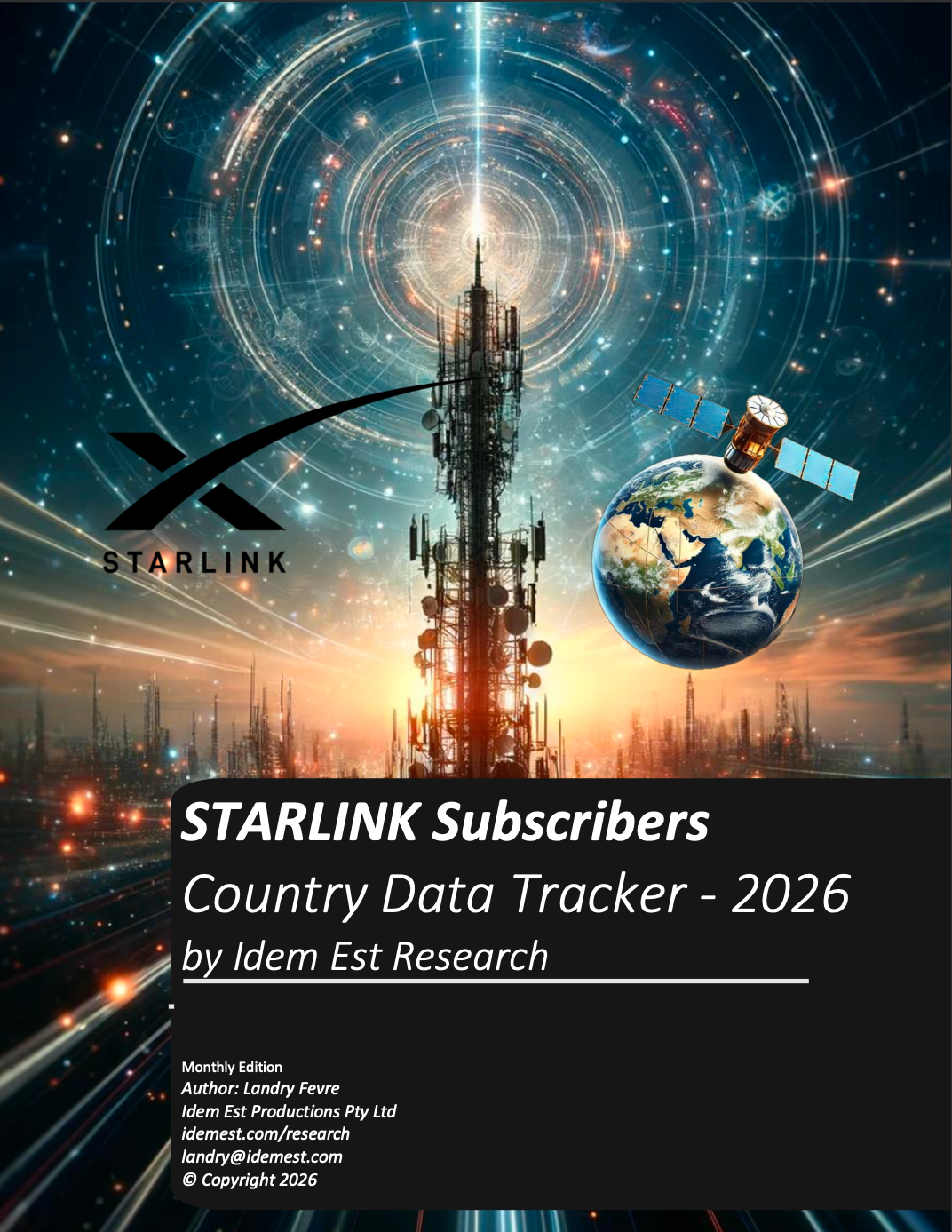
Introducing the Starlink Subscribers by Country Data Tracker – 2026
As featured in Le Monde, Bloomberg, L’Echo and more publications…
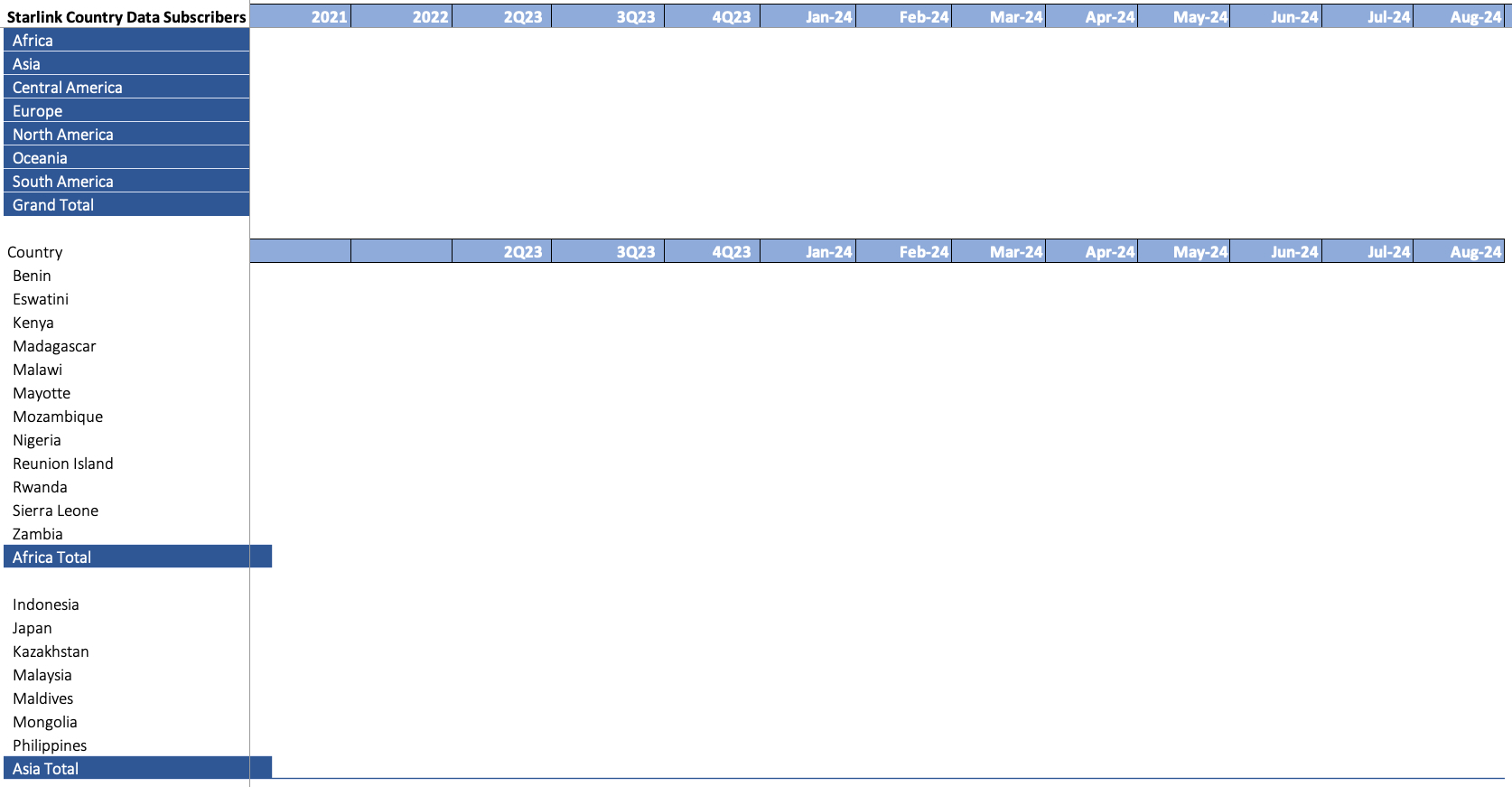
The Starlink Subscribers by Country Data Tracker – 2026 is a powerful tool designed to provide ongoing insights into the satellite internet market, with a specific focus on Starlink’s rapid expansion and impact globally. Tracking Starlink subscriber by country data on a monthly or quarterly basis across key countries such as the US, Brazil, Nigeria, Malaysia, the Philippines, Indonesia, and Japan, this tracker offers invaluable data for telecom industry professionals, investors, and businesses looking to understand the evolving satellite broadband landscape.
🔍 Five Compelling Reasons to Buy the Starlink Subscribers by Country Data Tracker – 2026
-
Real-time competitive intelligence
You get up-to-date subscriber counts by country (monthly or quarterly). That’s gold for spotting where Starlink is gaining traction before your competitors do.
-
Mitigate strategic, regulatory & market risk
The tracker highlights regulatory shifts, deployment constraints, market saturation, and geopolitical red flags—letting you anticipate threats rather than react after they hit.
-
Data-driven strategic planning & forecasts
With forecasts tied to historical growth trends, you can align your CAPEX, marketing, partnerships, and expansion moves based on high-confidence scenarios.
-
Opportunity spotting & entry timing
By observing underpenetrated markets or countries with accelerating uptake, you can time your entry (or partnership moves) to catch growth waves early.
-
Benchmarking & partner/competition insight
Use the data to benchmark your own satellite, terrestrial or hybrid broadband efforts against Starlink; evaluate partner or competitor strategies (e.g. where they’re underperforming) and recalibrate your own moves.
🌐 Potential Buyers & Use Cases (Telecom, Digital Inclusion, Regulation)
|
Stakeholder Type |
What They Get / Why They Care |
|---|---|
|
Traditional Telcos / CSPs |
To monitor cannibalisation threats in rural/underserved areas; to inform decisions on whether to invest in their own satellite solutions or hybrid models |
|
Satellite / LEO / Space Infrastructure Vendors |
To benchmark their own rollout plans, assess competitive gaps, and target markets with weak Starlink presence |
|
National Telecom Regulators / Policy Bodies |
To track how Starlink is expanding in their jurisdiction, anticipate license / spectrum demands, ensure fair competition, protect digital sovereignty |
|
International Development Agencies / NGOs |
To evaluate how Starlink is contributing (or not) to digital inclusion, connectivity in remote or underserved areas, and measure impact vs expectations |
|
Investors / Private Equity / Infrastructure Funds |
To assess growth trajectories, revenue potential, market saturation thresholds, and entry/exit timing for investments in satellite or telco plays |
|
Technology / Infrastructure Integrators |
To identify markets where demand for last-mile satellite backhaul, hybrid connectivity or edge services may emerge |
|
Consultancies & Strategy Firms |
To incorporate “Starlink penetration curves” into forecasts, advisories, country reports, and strategic roadmaps for clients |
|
Governments / Defense / Policy Analysts |
For geopolitical mapping (e.g. which countries Starlink is active in), assessing resilience of national communications infrastructures |
Key Highlights:
– Satellite Launches: Over 12,230 satellites have been launched, with a target of 20,000. In 2025 alone, Starlink launched satellites at a rate of 264 per month.
– DTC Satellite Launches: Over 663 Direct to Cell satellites since 2024, allowing TXT messages, upcoming voice and data services from a standard mobile phone via the DTC Starlink satellite infrastructure.
– Subscribers & Revenue: As of March 2026, Starlink had over 10.4 million global subscribers, with estimated 2025 revenues exceeding USD 18 billion. Detailed subscriber breakdowns by country and region are included.
– Growth & Reach: Starlink is now available to over 3.2 billion people, expanding rapidly across North America, the Middle East, the Asia Pacific region, and other key markets.
Starlink Subscribers (000’s) estimated by region as of the end of March 2026, country breakdown included in the report:
| Region | Dec-24 | Mar-25 | Jun-25 | Sep-25 | Dec-25 | Mar-26 |
|---|---|---|---|---|---|---|
| Africa | 221 | 263 | 388 | 527 | 687 | 1,016 |
| Asia | 427 | 752 | 1,245 | 1,471 | 1,627 | 1,873 |
| Central America | 118 | 145 | 184 | 207 | 259 | 318 |
| Europe | 458 | 513 | 505 | 566 | 607 | 755 |
| Middle East | 48 | 74 | 113 | 126 | 290 | 374 |
| North America | 2,449 | 2,578 | 2,637 | 3,193 | 3,678 | 3,985 |
| Oceania | 385 | 425 | 504 | 566 | 619 | 698 |
| South America | 535 | 613 | 793 | 936 | 1,242 | 1,364 |
| Total (k) | 4,642 | 5,363 | 6,372 | 7,589 | 9,010 | 10,383 |
Latest Starlink Developments:
| Date | Starlink Developments |
|---|---|
|
Q1 2026 |
|
|
2025 |
|
|
2024 |
|
| 2023 |
|
The Intersection of Technology and Geopolitics
Starlink’s global satellite coverage is deeply intertwined with geopolitics, highlighting the growing intersection between technology and international relations. Its expansive satellite network raises critical concerns about digital sovereignty, especially due to Elon Musk’s decisive control over its operations. For instance, his refusal to permit its use in specific military applications underscores the complexities of its governance. Moreover, as Starlink navigates a mix of regulatory challenges and potential strategic partnerships across the globe, its dominance in space infrastructure becomes increasingly significant. This positioning not only serves as a soft power tool for the United States but also introduces potential concerns regarding space traffic and orbital congestion. Although Starlink’s primary focus remains commercial, its profound influence on global geopolitics and its role in reshaping connectivity norms are becoming more apparent with each passing development.
Opportunities in Satellite Broadband
Satellite broadband’s potential in Africa and the Asia Pacific region is immense. By supporting a deep dive into its market dynamics, socioeconomic impacts, environmental considerations, technological evolution, and the importance of policies and collaboration, this report offers a comprehensive overview of the opportunities and challenges the region faces.
Why This Report is Essential
The Starlink Country Data Tracker provides comprehensive, ongoing data on Starlink’s subscriber base, financials, and technological developments. With insights into Starlink’s global expansion, market position, and its potential to bridge the digital divide, this tool is indispensable for businesses, investors, and policymakers aiming to stay ahead in the rapidly evolving satellite broadband market.
Pricing for the Starlink Country Data Tracker:
ONE COUNTRY
– One-Off Tracker: US$618 (includes a single update , delivered upon purchase)
– Quarterly Tracker: US$1,045 (4 quarterly updates, delivered 10 days after the end of each quarter)
– Monthly Tracker: US$1,863 (12 monthly updates, delivered 10 days after the end of each month)
ALL COUNTRIES
– One-Off Tracker: US$2,350 (includes a single update , delivered upon purchase)
– Quarterly Tracker: US$4,000 (4 quarterly updates, delivered 10 days after the end of each quarter)
– Monthly Tracker: US$7,000 (12 monthly updates, delivered 10 days after the end of each month)
By subscribing to the Starlink Country Data Tracker, you gain access to cutting-edge data and forecasts that are crucial for navigating the future of satellite internet and telecommunications. Don’t miss out on the opportunity to stay informed and ahead in this fast-moving market!
This product release was published on openPR.
About this report:
20th Edition
Author: Landry Fevre
Publication Date: March 2026
License: Single User
Other Idem Est Research Telecoms Country Reports:
ASEAN-4 Internet Exchanges & CDNs – Analysis of IX capacity, CDN deployment, and hyperscaler strategies in the ASEAN region
Australia, Bangladesh, China, India, Indonesia, Japan, New Zealand, Malaysia, Myanmar, Pakistan, Philippines, Singapore, South Korea, Taiwan, Thailand, Vietnam – A concise, data-driven overview of the country’s telecom market
Asia Pacific Telecom Towers – Market snapshot of tower ownership, tenancy ratios, lease rates, build-to-suit pipelines, and M&A across APAC.
Asia Pacific Satellite Internet, – Analysis of GEO/MEO/LEO capacity, coverage, pricing, and regulatory environments across APAC
Starlink Company Profile, – Deep dive on Starlink’s network architecture, satellite fleet, spectrum/licensing, pricing, and product roadmap (residential, business, mobility, backhaul). Includes competitive landscape, partnerships, regulatory status by key markets, and revenue/ARPU trajectory
Starlink Country Data Tracker – Starlink availability, by country, monthly subscribers update by country (160+)