Description
WHY YOU SHOULD BUY THE STARLINK COMPANY PROFILE – 2026:
- Benefit from the latest market opportunities
- Understand the threats to your operations and investments and protect your company against future risks
- Gain insights on emerging trends supporting, enhancing or disrupting your activities in the market
- Get a full view of the competitive landscape to assess your market position.
- Forecasts as a key input for successful budgeting and strategic business planning in the telecoms market
- Target business opportunities and risks in the telecoms sector through our reviews of latest industry trends, regulatory changes and major deals, projects and investments
- Assess the activities, strategy and market position of your competitors, partners and clients via our Starlink Company Profile
The Starlink Company Profile 2026 is available as a standalone report or as a pre IPO pack bundled with a Starlink DCF valuation model and a Starlink subscriber tracker. Packages are offered through the Idem Est Research online store, with pricing ranging from AUD 2,188 to AUD 5,688 (with currency options including USD, EUR and GBP).
The report is the 4th edition, spans 72 pages, and is published under a single user PDF license
Starlink Company Profile – 2026
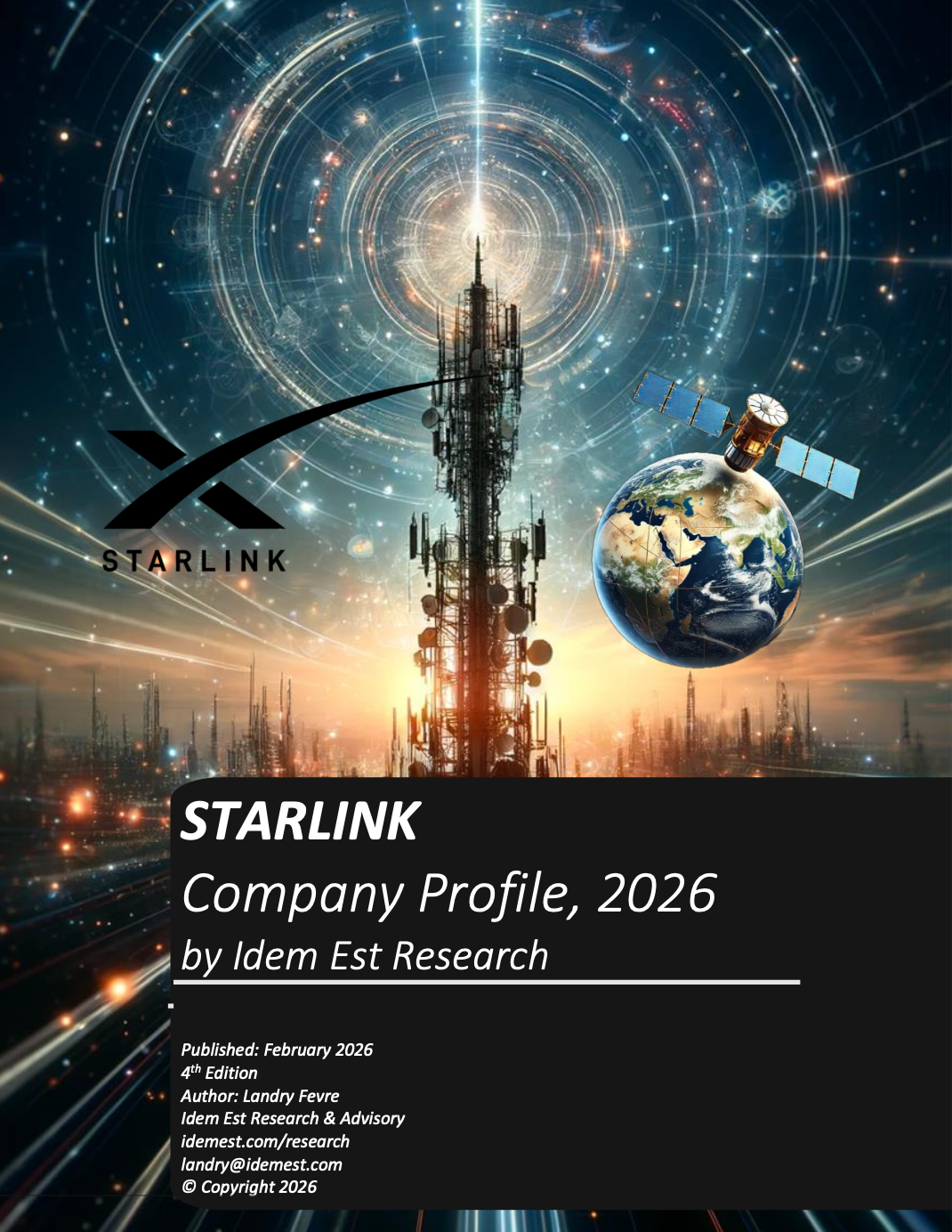
Starlink, a subsidiary of SpaceX, aims to provide global high-speed satellite internet connectivity through a massive constellation of low Earth orbit (LEO) satellites. The report provides an in-depth look at Starlink’s technology, expansion plans, partnerships, estimated finances and future outlook.
Key Highlights:
– Satellite Launches: Over 11,000 satellites have been launched, with a target of 12,000. In 2024 and 2025 alone, Starlink was launching at a rate of 165 and 152 satellites per month, respectively.
– Subscribers & Revenue: As of January 2026, Starlink had over 9.4 million global subscribers, with estimated 2025 revenues exceeding USD 11.6 billion. Detailed subscriber breakdowns by country and region are included.
– Growth & Reach: Starlink is now available to around 3.2 billion people, expanding rapidly across North America, the Asia Pacific region, and other key markets.
– The Starlink Company Profile – 2026 includes forecasts to 2040, Revenue, Capex and enterprise value (EV) valuation.
– Latest Starlink comprehensive data and valuation update support our base case EV valuation to over USD313 billion
– Competitors like OneWeb and Amazon’s Project Kuiper lag significantly behind Starlink in deployment, though new LEO constellations from China and India could emerge as challengers.
– The integration of satellites with 5G networks, known as 5G NTN, promises enhanced connectivity. Starlink plans to offer DTC direct-to-cell or Direct-to-device messaging services in 2024.
– While satellite broadband improves socioeconomic development, environmental concerns like space debris need to be addressed through sustainable operating practices.
Starlink Subscribers (000’s) estimated by region as of the end of December 2025, country breakdown included in the report:
| Region | Dec-24 | Mar-25 | Jun-25 | Sep-25 | Dec-25 |
|---|---|---|---|---|---|
| Africa | 221 | 263 | 388 | 528 | 687 |
| Asia | 439 | 763 | 1,232 | 1,462 | 1,601 |
| Central America | 118 | 145 | 184 | 207 | 259 |
| Europe | 507 | 591 | 635 | 707 | 747 |
| Middle East | 48 | 74 | 113 | 126 | 149 |
| North America | 2449 | 2,578 | 2,640 | 3,193 | 3,678 |
| Oceania | 385 | 425 | 505 | 566 | 619 |
| South America | 535 | 613 | 793 | 934 | 1,203 |
| Total (k) | 4,704 | 5,452 | 6,489 | 7,723 | 8,943 |
Starlink Developments:
| Date | Starlink Developments |
|---|---|
| 2025 |
|
| 2024 |
|
| 2023 |
|
Crucially, the Starlink project intersects with geopolitics; its comprehensive satellite coverage raises concerns about digital sovereignty, especially given Musk’s decisive control over its use, as evidenced by his refusal to allow its use in certain military applications. Facing a blend of regulatory challenges and potential strategic partnerships worldwide, Starlink’s dominance in space infrastructure positions it as both a soft power tool for the U.S. and a potential source of space traffic concerns. While primarily commercial, Starlink’s deep intertwining with global geopolitics is increasingly evident as it redefines connectivity norms.
Satellite broadband’s potential in Africa and the Asia Pacific region is immense. By diving deep into its market dynamics, socioeconomic impacts, environmental considerations, technological evolution, and the importance of policies and collaboration, this report offers a comprehensive overview of the opportunities and challenges the region faces.
Overall, the report provides a comprehensive overview of Starlink’s technological capabilities, financials including revenue, EBITDA, Capex and other key KPIs, global expansion roadmap, estimated market position and future potential to bridge the digital divide in the next decade. It highlights the opportunities and challenges facing Starlink and the satellite broadband industry as a whole.
KEY COMPANIES MENTIONED IN THIS STARLINK COMPANY PROFILE – 2026:
AST Spacemobile, Eutelsat, Globalstar, Inmarsat, IPStar, Kacific, Kuiper, Lynk, Measat, NBN, OneWeb, SpaceX, Starlink, Viasat.
Starlink Company Profile – 2026 – Table of Contents
1 The Race For The Last 5%
2 Satellite Internet Connectivity: An Overview
2.1 Satellite Internet Basics
2.2 Comparing LEO, MEO, and GEO Satellite Orbits
2.2.1 LEO and GEO Satellite Comparison
2.3 Satellite Frequency Bands
2.3.1 Ku-band
2.3.2 Ka-band
2.3.3 C-band
2.3.4 L-band
2.3.5 Other Satellite Bands
2.4 Satellite Broadband Providers Operators, 2026
3 Starlink Profile
3.1 Starlink Satellite Launches per Year
3.2 Starlink Geopolitical Clout
3.3 Starlink Partnerships around the World
3.4 Starlink Technology & Capacity
3.5 Starlink Direct to Cell
3.6 Starlink Subscriber Estimates by Country, 2021-2025
3.7 Starlink Key Performance Indicators Forecast, 2023-2035
3.8 Starlink Financials – Revenue, EBITDA and Capex Estimates, 2023-2031
4 Other Satellite Operators Profile
4.1 Project Kuiper Profile
4.2 Eutelsat OneWeb Profile
4.3 AST Space Mobile Profile
4.4 China’s GuoWang constellation Profile
4.5 Lynk Profile
4.6 Other LEO Constellation Projects
4.6.1 China’s Thousand Sails Constellation
4.6.2 China’s Geespace
4.6.3 India Satellite Internet Key Players
4.6.4 Key Challenges and Considerations for New Entrants:
5 5G NTN: The Next Generation of Satellite Connectivity
5.1 5G NTN Overview
5.1.1 The Rationale Behind 5G NTN
5.1.2 Technical Aspects of 5G NTN
5.1.3 Potential Applications for 5G NTN
5.1.4 Challenges in Implementation
5.2 5G NTN Satellite Providers
6 Evaluating the Impact of Satellite Broadband Connectivity
6.1 Socioeconomic Impact
6.2 Environmental Considerations
7 Future Prospects of Satellite Broadband and 5G NTN
7.1 Expanding Geographical Reach
7.2 Addressing Infrastructure Limitations
7.3 Enhancing Data Throughput and Latency
7.4 Facilitating the Internet of Things (IoT) and Edge Computing
7.5 Disaster Recovery and Emergency Services
8 Conclusion
9 Methodology
10 Copyright Notice
Figure 1 – Satellite Deployments Type
Figure 2 – Satellite frequency bands
Figure 3 –Starlink and OneWeb Satellite Launches per Month (Data until Jan-26)
Figure 4 –Satellite Launches including Starlink per Year (Data until Dec-25)
Figure 5 –Starlink Capabilities
Figure 6 –Starlink User Terminals
Figure 7 –Starlink Ground Stations & Gateways
Figure 8 –Starlink Optical Space Lasers
Figure 9 –Starlink Optical Inter-satellite links (ISL)
Figure 10 –Starlink Satellite Capacity
Figure 11 –Starlink Satellite Direct to Cell
Figure 12 –Starlink Subscribers (k) Worldwide Since Launch
Figure 13 – Starlink Regional Subscriber Mix – 2023-2025
Figure 14 – Starlink Revenue, EBITDA and Capex Estimates, 2020-2035 (USD m)
Figure 15 – Starlink Free Cash flow (USD bn), 2020-2040
Table 1 – Satellite Orbit Altitudes
Table 2 – LEO and GEO Satellite Comparison
Table 3 – Satellite Broadband Operators, 2026
Table 4 – Starlink Partnerships, 2026
Table 5 – Starlink Subscribers (k) by Region since Launch, 2021-25
Table 6 – Starlink Subscribers by Country 2023-2024, as of December 2025
Table 7 – Starlink KPIs, 2021-2031
Table 8 – Starlink Revenue, EBITDA and Capex Estimates, 2023-2035
Table 9 – Key 5G NTN and satellite to cellular providers (status early 2026)
This product release was published on openPR.
About this report:
4th Edition
Pages: 72
Author: Landry Fevre
Publication Date: February 2026
License: Single User PDF
Other Idem Est Research Telecoms Country Reports
Australia, Bangladesh, China, India, Indonesia, Japan, New Zealand, Malaysia, Myanmar, Pakistan, Philippines, Singapore, South Korea, Taiwan, Thailand, Vietnam,
Asia Pacific Telecom Towers, Asia Pacific Satellite Internet, Starlink Company Profile